The Low-Growth Paradox: Why AI isn't Taking Jobs, It's Raising the Rent on Talent
1. A Decoupling of the Labor Market
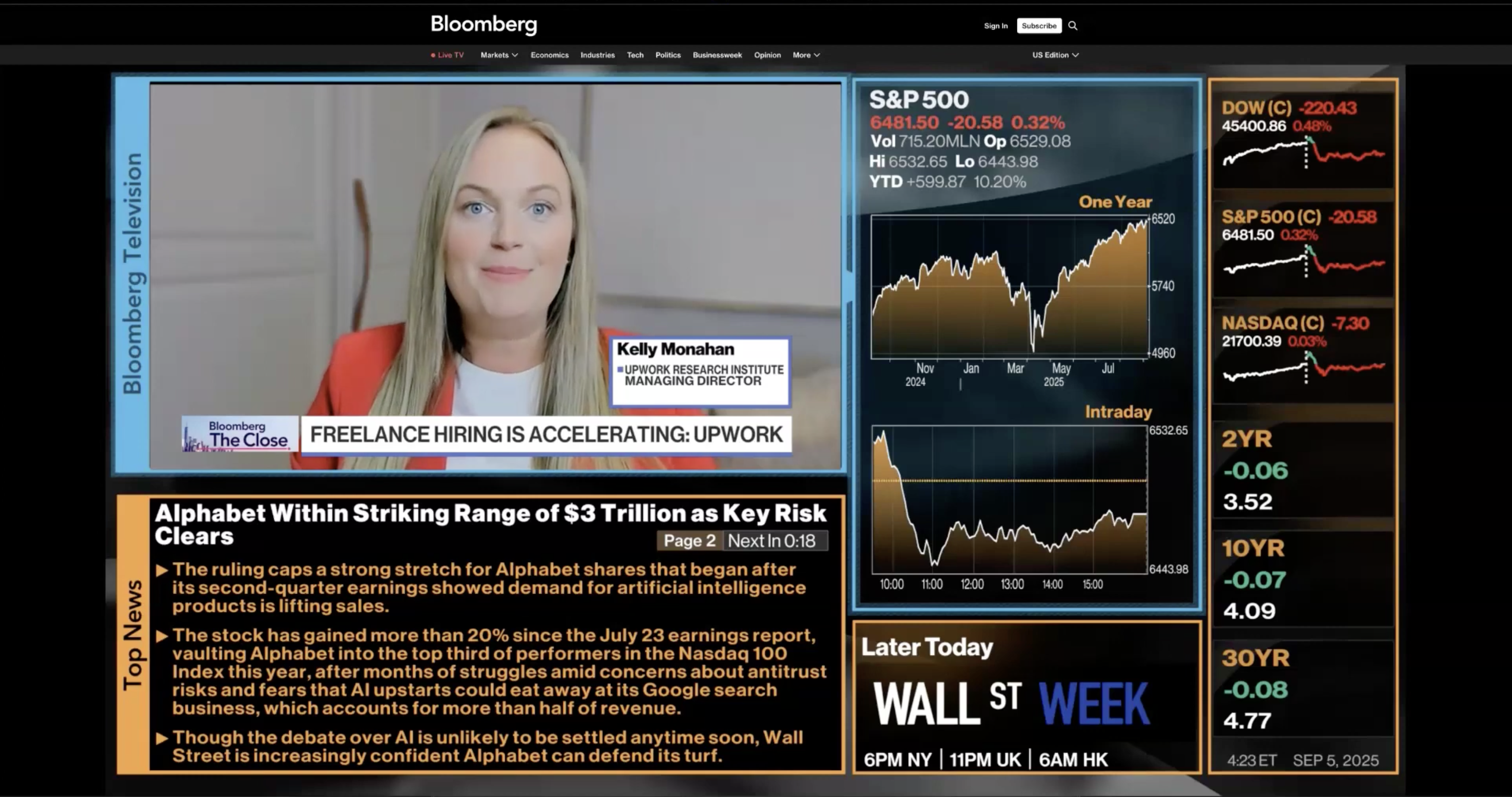
The traditional labor market is currently witnessing a stark decoupling. While standard payroll reports signal a softening contraction in full-time employment, the freelance economy is operating on an entirely different frequency—one defined by high-signal growth in AI-augmented roles. If full-time hiring is cooling, why is specialized freelance talent suddenly in such high demand? Data from the Upwork Research Institute suggests we are in the midst of a structural shift that favors agility over traditional headcount.
2. The Agility Pivot: Turning Low Growth into Internal Innovation
We are entering a climate where 55% of business leaders are bracing for a "low to no growth" environment. In this stagnating landscape, the strategic focus has shifted from chasing speculative external growth to maximizing internal innovation. This shift has triggered a massive 41% surge in AI and machine learning job postings.
Rather than anchoring their balance sheets with the overhead risks of full-time hires, organizations are leveraging specialized freelancers—experts in Python and machine learning—to build and operate AI systems. This move toward operational agility allows firms to iterate quickly without the long-term liabilities of traditional hiring.
3. The 90% Liability: Why Humans are the Ultimate AI Quality Control
As AI moves from the "play phase" into the "production phase," a critical technical gap has emerged. Even the most sophisticated models are only correct roughly 90% of the time. In a professional environment, that 10% error rate isn't just a glitch; it’s a liability that requires a premium "human-in-the-loop" service to mitigate.
Demand is surging for specialists who can provide the final layer of human judgment, evaluation, and rigorous fact-checking. As organizations realize that automated efficiency is worthless without accuracy, the role of the human evaluator has become the essential safeguard for AI-generated output.
"Bringing those humans back in to really evaluate and fact check the output is beginning to grow in great demand on our platform today." — Dr. Kelly Monahan, Managing Director at Upwork Research Institute.
4. The Layoff Myth: Balancing Books, Not Replacing Brains
The prevailing narrative that AI is currently the "executioner" of the workforce is largely unsupported by the data. In August, exactly 0% of layoffs were attributed to AI or emerging technology. The reality is far more mundane: companies are cutting costs to maintain their balance sheets in a flat economy.
While the prospect of fully autonomous "AI agents" replacing entire roles remains years down the road, the current labor shift is driven by economic pressure, not technological substitution. For now, humans remain the indispensable decision-makers and judgment-callers required to navigate complex business environments.
5. The Creator Paradox: Raising the Floor on Technical Skill
The creator economy—comprising content creation, web design, and social media strategy—now accounts for 15% of all US jobs posted on the Upwork platform. Far from being automated into obsolescence by SMBs, these roles are undergoing a rapid evolution.
The bar for entry has been raised: these positions now require two times the amount of AI skills compared to previous years. This "2x factor" proves that jobs aren't being deleted; they are being augmented. The modern creator is no longer just a stylist or a writer; they are an AI-enabled strategist who uses technology to amplify their unique human perspective.
6. The Return to Human: Aesthetics as a Competitive Advantage
In a market increasingly saturated with generic, automated content, we are seeing a significant aesthetic pivot. Forward-thinking businesses are moving away from the "obviously AI" look, recognizing it as a brand liability.
There is a growing "return back" to human-centric quality. This trend is a powerful wage protector for creators who can offer a level of nuance and craft that AI cannot replicate. In the age of infinite automated content, human-centricity has become a primary competitive advantage and a premium differentiator.
7. Conclusion: The New Talent Playbook
The old talent models are fracturing under the weight of a new economic reality. As leaders pivot from seeking external expansion to fostering internal innovation through agility, the "talent playbook" is being rewritten in real-time.
We are not entering a jobless future, but a future where the rent on talent has been raised. The question for every professional and business leader is no longer whether AI will affect your role, but how quickly you are evolving your playbook to lead this structural shift. How are you positioning yourself for a market that prizes agility over stability?
.png?width=512&height=512&name=color-icon-circle-favicon%20(7).png)